
From Meishi to the Elevator Pitch: Why Global Professionals Need Both
If you work across Japanese and Western business cultures, the way you introduce yourself can quietly build trust—or undermine it in the first 60 seconds.
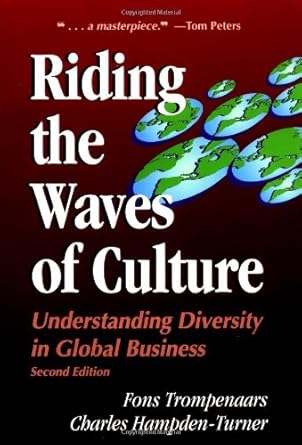
If you work across Japanese and Western business cultures, The Culture Map (Erin Meyer) and Riding the Waves of Culture (Fons Trompenaars) should be required reading. Trompenaars’ work, first published nearly 30 years ago, explores the deeper values that shape how credibility is earned. Meyer builds on this foundation with a modern, practical lens, showing how those cultural differences play out in everyday communication, leadership, and decision-making.
Together, they reveal a challenge I see every day in global teams: we often underestimate how differently trust and credibility are established, and how quickly misalignment can occur.
Designed for Japanese professionals working globally—and Western professionals working in Japan.
This matters if you are:
– A Japanese professional presenting yourself in global meetings
– A Western leader working with Japanese teams or clients
– A manager responsible for cross-border collaboration and trust
In all three cases, how you introduce yourself sets the tone for everything that follows.
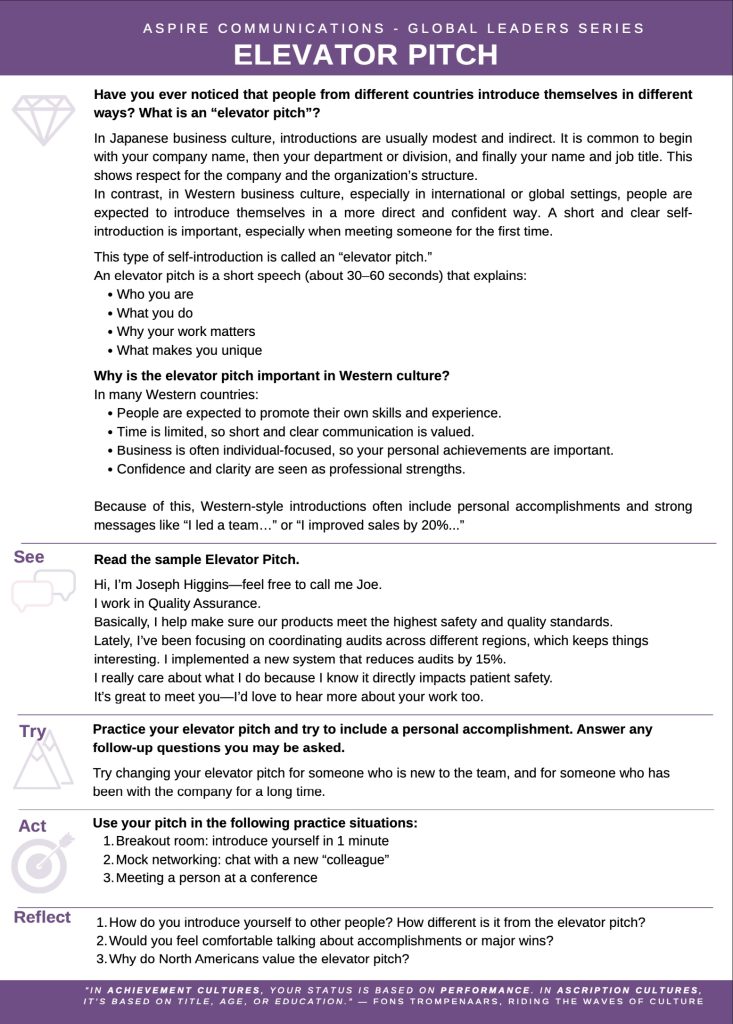
To help professionals navigate this difference, I’ve put together a short, practical guide on building an effective elevator pitch for global business, while remaining true to yourself and your cultural values.
Riding the Waves of Culture
- Focus: How people reconcile cultural dilemmas
- Core idea: Culture is about balancing opposing values
- Model: 7 dimensions of culture
- Strength: Explains why cultures behave differently
- Best for: Leadership, organizational design, change management
- View of culture: Dynamic and context-dependent
The Culture Map
- Focus: How culture affects day-to-day work
- Core idea: Culture shapes communication, feedback, and decision-making
- Model: 8 behavioral scales
- Strength: Highly practical and easy to apply
- Best for: Global teams, collaboration, management practices
- View of culture: Comparative and behavior-focused

Today, I want to focus on something we often take for granted—self-introductions—and how differently it’s approached depends on whether you were raised in Japan, North America, or Europe.
In Japan, trust is largely ascription-based (Trompenaars), or relationship-based (Meyer). Your company, department, title, and seniority speak for you. Modesty (謙虚) is a professional strength, and individual achievements and credibility are understood through the organization.
In my workshops, Japanese participants often introduce themselves by saying how long they’ve been with their company. I still remember one participant—let’s call him Mr. Y—who said he’d been with the same pharmaceutical company for 25 years.
At the time, I was younger and hadn’t fully absorbed Trompenaars’ insights. My first (very Western) reaction was: “Why haven’t you moved on?” To me, that length of service signaled stagnation, not success.
I was wrong (and, alas dead reader, not for the last time).
In many Western cultures, trust is achievement-based (Trompenaars) / result-based (Meyers). People expect an elevator pitch—a short, direct explanation of who you are, what you do, and what you’ve personally delivered. Results, impact, and individual contribution matter more than affiliation.
elevator pitch—a short, direct explanation of who you are, what you do, and what you’ve personally delivered.
There’s one person I’ve met who delivers a perfect elevator pitch every time at our Yokohama Business Society monthly meetings (if you’re in the area and interested, let me know). His pitch goes like this:
“I’m Mike Wiston. I’m the CEO and Founder of mowMedia and mowPod. We’re the largest podcast marketing company in the US, Canada, and the UK. I’m also the co-founder of the Friday Night Karaoke Facebook group with 50,000 members and host of the Friday Night Karaoke podcast, which has been a top-20 Apple podcast for the past two and a half years.”
It’s short. It’s clear. It’s full of achievements. And it made an impact (Thanks Mike!).
For many Japanese professionals, though, it could sound boastful.
And it’s this difference in introductions that often marks the beginning of friction in new business relationships.
Japanese professionals aren’t lacking confidence or language ability—they’re operating within a different trust system. But in global environments—meetings, conferences, client interactions—waiting to be asked or relying on title alone can mean being overlooked.
For Western professionals operating in Japan, the opposite can be true. Leading with personal achievements instead of company, team, or length of service can make you appear aggressive—or even arrogant.
So, like a coin, there are two sides to this.
For Japanese professionals operating globally:
An elevator pitch isn’t about abandoning Japanese values. It’s about cultural agility.
In achievement-based cultures:
- Individual contribution is currency
- Time is limited
- Direct communication is expected
- Modesty can be misread as uncertainty
For Western professionals operating in Japan:
An introduction is not the time to showcase personal accomplishments. It’s about group harmony, context, and modesty. In ascription-based cultures, credibility comes from affiliation and role—not self-promotion.
The most effective global professionals don’t replace one style with another—they build both.
Final thoughts…”When in Rome do as the Romans do…”
Your meishi still matters. So does your elevator pitch.
Credibility depends on using the right introduction for the right context.
So, how have you navigated introductions across Japanese and Western business cultures?
Bonus: For Japanese professionals working internationally, I’ve created a step-by-step PDF lesson on elevator pitches, designed specifically for global business settings. We use in our private coaching but it should be useful as a guide for you. Sign up for a free copy here.

I’m Steve Daly, President of Aspire Communications. We’ve been leading workshops on cross-cultural communication and global business skills in Japan since 2005. If you or your team want to move from local heroes to global leaders, I’d love to continue the conversation. Message me on Linkedin so we can avoid those pesky spambots.